Empowering Environmental Health Professionals
Welcome to the Massachusetts Environmental Health Association
Join us in celebrating 77 years of dedication to public and environmental health through education, advocacy, and professional development.


Membership

Events

Training

Donate
Upcoming Events
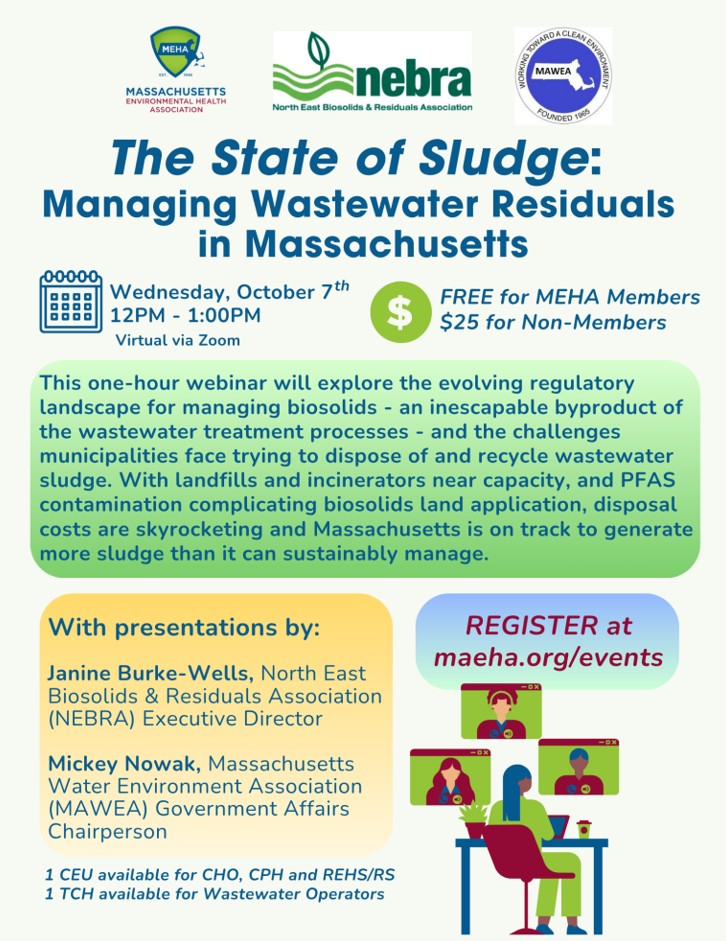
Webinar: The State of Sludge: Managing Wastewater Residuals in Massachusetts
Webinar: The State of Sludge: Managing Wastewater Residuals in Massachusetts
Webinar: The State of Sludge: Managing Wastewater Residuals in Massachusetts
Massachusetts Environmental Health Association
The Massachusetts Environmental Health Association (MEHA) has been a cornerstone in the field of Public and Environmental Health since its establishment in 1948. As an affiliate of the National Environmental Health Association (NEHA), MEHA is committed to advancing the professional development of its members through high-quality training and educational programs.
What We Offer
Educational Training & Seminars
Our workshops offer ongoing education opportunities for professionals to stay updated on the latest trends, technologies, and best practices in environmental health.
Professional Development
We offer a range of professional development opportunities, including interactive workshops, training programs , scholarships and our Ambassador Program.
MEHA Yankee Conference
MEHA’s annual conferences provide a platform for networking, learning, and sharing insights with peers and experts in the field of public and environmental health.
Online Learning Modules
We plan to offer a variety of online courses that allow professionals to learn at their own pace, covering a wide range of topics relevant to environmental health.
Check back soon!
MEHA News

MEHA Website Relaunch!
We are thrilled to announce the highly anticipated relaunch of the MEHA website, designed with you in mind, featuring an enhanced user experience...
Recent Success in Environmental Health in Massachusetts: A Milestone for Public Well-Being
Massachusetts has long been a leader in environmental health, consistently striving to protect its natural resources and ensure the well-being of its residents. In recent years, the state has achieved significant successes in this area, thanks to the dedication of environmental health professionals, policymakers, and community advocates.
MEHA 2024 Annual Conference Recap
The Massachusetts Environmental Health Association (MEHA) 2024 Annual Conference was a resounding success, bringing together environmental health...
Join Us in Making a Difference
Become a member of the Massachusetts Environmental Health Association and contribute to our mission of promoting public and environmental health. Participate in our upcoming events, training sessions, and professional development opportunities.